
Physiotherapy SOAP notes: free template, example and AI drafting
Key takeaways
- Copy the free SOAP template or download a fillable A4 or US Letter PDF, with no signup needed.
- Hanah can draft into your existing SOAP headings, a custom Cliniko template or the named fields in your own PDF.
- Use the consultation recording or dictate a short summary after the patient leaves; both give the note generator the clinical details to organise.
- The same visit can supply the SOAP note, a GP referral letter and the patient's home exercise plan.
- Saying "left knee flexion 115 degrees" gives the draft a finding, a side and a unit; "that's better" loses the measurement you want to track next time.
An AI SOAP note generator turns a consultation recording or a clinician's dictated summary into Subjective, Objective, Assessment and Plan sections. In physiotherapy, that means carrying the symptoms, measurements, examination findings and agreed exercise doses into the format you already use.
Hanah drafts physiotherapy SOAP notes in your own headings, into your existing Cliniko treatment template or into an uploaded Word or PDF form. The same visit can also supply a GP letter and the patient's home program. Below you'll find a free blank template, a worked shoulder-assessment example, and the workflow for turning the consultation into those documents.
Can an AI SOAP note generator use my existing template?
Yes. In Hanah, choose your existing SOAP note format or upload the Word or PDF template you use. On Cliniko, Hanah can read your custom treatment-note sections and draft into the matching fields. A template with separate boxes for range of motion, strength and special tests can keep those sections instead of becoming one long paragraph.
- Choose the format. Use your existing note headings, the fillable PDF below or your practice's own form.
- Capture the findings. Record the consultation, or dictate a short summary afterwards with the measurements, assessment and agreed plan.
- Generate the documents. Draft the SOAP note, then use the same visit context for the GP letter and home program.
- Review and file. Edit the drafts and save the note in the patient record. Approve the patient plan when it is ready to share.
Hanah also works standalone without a practice management system. For Cliniko, an API connection brings appointments into Hanah and supports note filing; the optional browser extension adds recording and drafting on the open patient page. These are separate connection options that can work together.
The Practice plan is A$100 per practitioner/month, or A$80/month billed annually, with unlimited sessions and supported integrations included. The AI scribe has a one-month trial without a credit card. The blank template and downloads below are free to use independently of that trial.
For a comparison of products, see AI scribes for physiotherapists. For therapy documentation, see AI therapy notes for psychologists.
Free physio SOAP note template
Copy the blank template below or download the fillable PDF (A4) or plain-text version. No account or email address is required. For US physical therapists, there is also a US English PDF (US Letter) and US English text version.
Hanah can draft into this PDF from your consultation. Create a free Hanah account, add the downloaded PDF as your own template, and use it with your recorded consultation and visit notes. Hanah fills the patient details and Subjective, Objective, Assessment and Plan fields from that context. You supply the clinical judgement, check the findings, sides, numbers and exercise doses, and review the draft before finalising it. See how to use your own PDF template in Hanah.
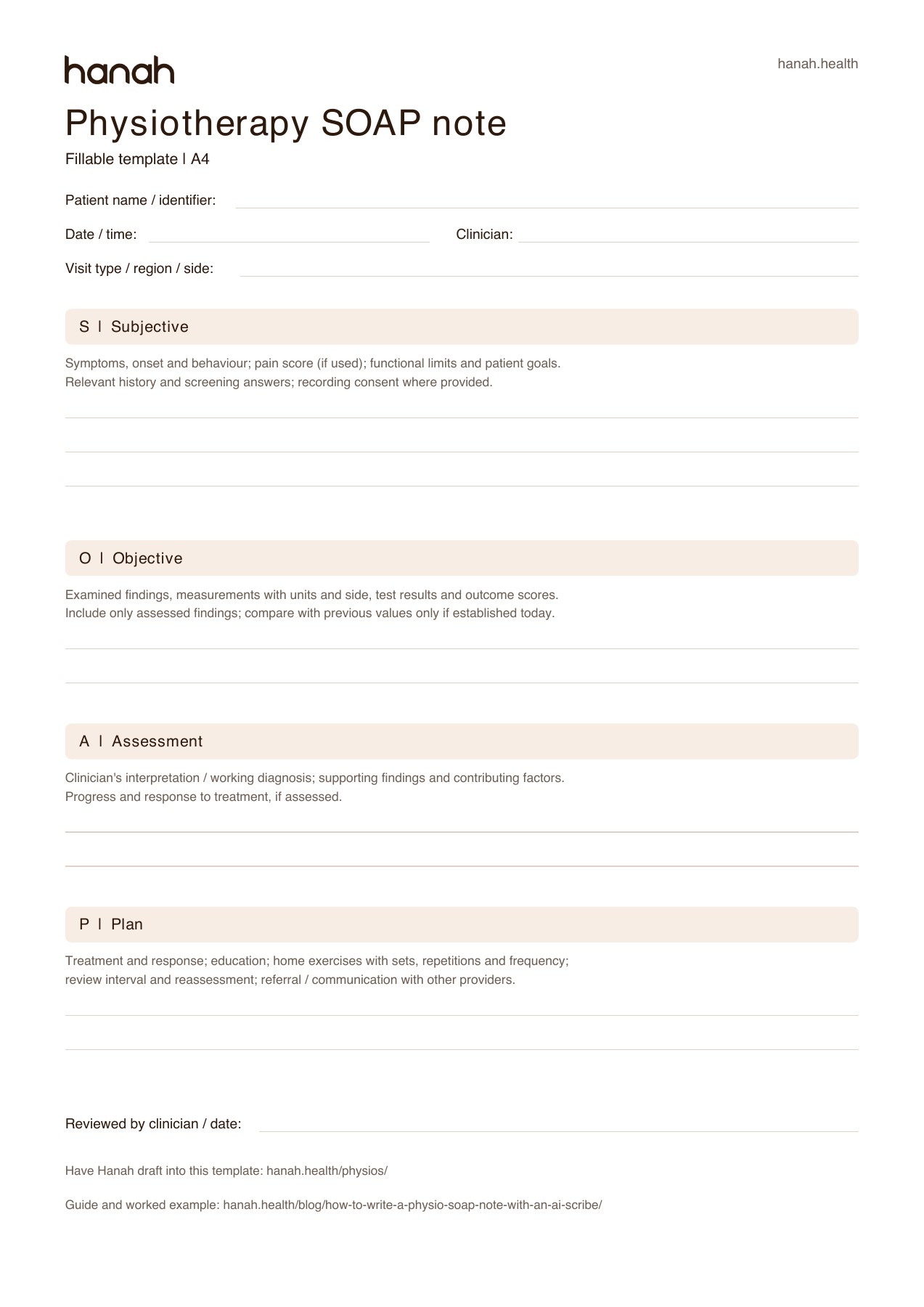
Preview of the A4 PDF. Select it to open the fillable file. You can type into the PDF, have Hanah draft into it, or print it and write by hand.
Adapt the prompts to the consultation and your workplace's requirements. Record only the history, screening answers, findings and care actually established in the session; an unperformed test or unanswered screening question is not a normal or negative finding.
PHYSIOTHERAPY SOAP NOTE

Patient name / identifier: [ ]
Consultation date and time: [ ]
Clinician: [ ]
Visit type / body region and side: [ ]

S - SUBJECTIVE
Symptoms, onset and behaviour: [ ]
Pain score and context (if used): [ ]
Functional limitations and patient goals: [ ]
Relevant history and screening answers: [ ]
Consent to recording (if applicable): [ ]

O - OBJECTIVE
Examination findings, with region and side: [ ]
Measurements and outcome scores, with units: [ ]
Tests performed and their results: [ ]
Change from previous findings, if established today: [ ]

A - ASSESSMENT
Clinician's interpretation / working diagnosis: [ ]
Supporting findings and contributing factors: [ ]
Progress / response to treatment, if assessed: [ ]

P - PLAN
Treatment provided and response: [ ]
Education and agreed actions: [ ]
Home exercises, with sets, repetitions and frequency: [ ]
Review interval and what to reassess: [ ]
Referral / communication with other providers: [ ]

Reviewed by clinician / date: [ ]
How can Hanah draft into this SOAP template?
Add the fillable PDF to your templates in Hanah, then select it when generating a document from the visit. Ask for the SOAP note from the consultation: Hanah drafts into the PDF's named fields, rather than giving you text to paste into each box. You can also use Hanah's existing physiotherapy SOAP note format if you prefer an editable note instead of a PDF.
Say the objective findings aloud with the measurement, unit and side, or type them into the visit notes. State your assessment and agreed plan, including exercise doses. The template gives Hanah a structure; it does not supply missing examination findings or make the clinical decisions for you. The review line is left for the clinician to complete.
What goes in each section of a physio SOAP note?
- Subjective is the patient's account: how the problem started, where and how much it hurts (with a score such as NRS where you use one), what makes it worse or better, what they can't do, what they want to get back to, and relevant history and screening answers.
- Objective is what you found: observation, active and passive range of motion in degrees, strength as a grade or a dynamometer reading, special tests with side and result, neurological screen, palpation, and any outcome measure scores.
- Assessment is your interpretation: the likely source of symptoms, contributing factors, and how today compares with last time.
- Plan is what you did and what happens next: treatment given, education, the home program with its dose, the review interval, and any referral or report.
Hanah's physio SOAP template follows the same shape. Its instructions ask for the Subjective as one short paragraph, in the patient's own words where that helps; Objective findings one per line with figures and units, leaving out anything not assessed; the Assessment in one or two sentences, leading with the symptom and then the likely condition; and the Plan as short, action-first points.
What does the scribe need to hear you say?
A scribe can't see your goniometer. If a finding isn't said, it isn't in the transcript, and it won't be in the note. Five habits make most of the difference:
- Say the number, the unit and the side. "Left knee flexion 115 degrees" is recordable. "That's better" isn't.
- Say the test and the result. "Lachman's negative on the left, McMurray's painful but no click."
- Say the comparison. "Up from 95 last week." Hanah uses the last version of the same note for this patient as a guide to structure and to what you tracked, and it's instructed not to carry old values forward: every figure in today's note has to be supported by today's session.
- Say the dose. "Three sets of twelve, once a day." That's what the patient's home program will carry.
- Say the red flags you cleared. "No night pain, no pins and needles, bladder and bowel normal." A negative screen you don't voice can't be recorded.
Before any of this, ask the patient's consent to record and note their answer. Ahpra's guidance says an AI scribe that records the consult will generally need informed consent, ideally noted in the record (Ahpra).
What does a finished note look like?
This is an illustrative example. "Sam" is a fictional patient, and we wrote the note to show the shape of a good one; it isn't output from a real consult.
Sam is 42, plays social tennis, and has had six weeks of right shoulder pain. Here's a fragment of what the physio said while examining:
"Right flexion's about 150, left is full, 175. Painful arc from 80 to 120. External rotation 70 on the right, 85 left. Resisted external rotation, that's a 4 out of 5 on the right and it hurts. Hawkins-Kennedy positive on the right, Neer's positive. Lag sign's negative, drop arm negative."
And the initial assessment, in the Standard register:
Subjective
Six-week history of gradual-onset right lateral shoulder pain after increasing tennis to four sessions a week. NRS 6/10 reaching overhead and serving, 2/10 at rest. Wakes when lying on the right side. No trauma, no neck pain, no pins and needles. Goal: serve pain-free before the club season in eight weeks.
Objective
- R shoulder flexion 150° (L 175°)
- Painful arc 80–120° abduction, R
- R ER 70° (L 85°)
- Resisted ER 4/5 R, painful; 5/5 L
- Hawkins-Kennedy positive R; Neer's positive R
- ER lag sign negative; drop arm test negative
- Cervical screen clear
- PSFS: serving 3/10, reaching overhead 5/10
Assessment
Right lateral shoulder pain with a painful arc, positive impingement tests and painful resisted external rotation, consistent with rotator cuff related shoulder pain following a rapid increase in tennis load.
Plan
- Education on load: serving paused for two weeks, groundstrokes continue if pain stays at or under 3/10
- Home program: banded shoulder external rotation 3 × 12 daily; shoulder wall slide 2 × 10 daily
- Sleeping position advice
- Review in one week: re-test resisted ER and painful arc, progress load
Notice what isn't there. No internal rotation figure, because it wasn't measured. No palpation findings, because none were said. A good scribe leaves the gap for you to fill rather than filling it for you.
How is a progress note different?
It's shorter, and it's mostly about change. Hanah's physio progress note starts in clinical shorthand and the initial assessment in the Standard register, and you can switch either. Sam's review a week later might read:
S: R shoulder NRS 4/10 overhead (was 6). Doing HEP ~5 days/wk. Groundstrokes OK.
O: Flex 165° (was 150). Painful arc 100–120°. Resisted ER 4+/5, pain-free.
A: Improving; tolerating load.
P: Progress ER to 3 × 15, add prone Y. Serving paused one more week. RV 1/52.
Those "was" figures appear only because the physio said them aloud during the review.
How do I check the draft before I sign it?
The record is yours, whoever typed it. Ahpra's AI guidance says a practitioner using an AI scribe is responsible for checking the accuracy and relevance of the records it creates. The records expectations don't change either. In Australia, the Code of conduct summary asks for records that are accurate, up to date, factual and legible, made at the time or as soon as possible afterwards (Ahpra). In the UK, HCPC standard 10 asks for full, clear and accurate records, completed promptly (HCPC). In New Zealand, the Physiotherapy Board's health records standard expects records another physiotherapist could continue care from, with red flags, cautions and contraindications recorded (Physiotherapy Board of New Zealand).
A two-minute check that covers most errors:
- Sides. Every finding has the right side. Laterality is the easiest thing to get wrong and the most important to get right.
- Numbers. Every figure matches what you measured, with its unit.
- Tests. Only tests you performed, with results the right way round.
- Gaps. Anything you found but didn't say out loud. Add it now.
- Extras. Anything you didn't say or do. Delete it.
- Dose. The home program in the Plan matches what you told the patient.
- Consent and red flags. Both noted.
In Hanah, nothing becomes part of the record until you've reviewed and signed it. If you want to know how often a scribe gets things wrong before you trust it, ask for measured error rates. Ours are in our accuracy and hallucination report.
Where does the Plan go after the note?
The Plan is also the start of the patient's home program. In Hanah, the same consult drafts a care plan the patient reads on their phone, with an exercise card for each exercise you prescribed, picked from the library at the dose you stated. We cover that, and the reports to GPs that follow a course of treatment, in what a physiotherapist should look for in an AI scribe.
FAQ
Can I generate SOAP notes from dictation after the appointment? Yes. Record your summary in Hanah after the patient leaves, including the subjective history, objective measurements, your assessment and the agreed plan. Select your SOAP template and generate the draft from that dictated account. You can use the same visit context for a GP letter.
Is the SOAP note template free, or is the AI generator free? The blank template, text files and fillable PDFs are free, with no signup. Hanah's AI scribe is part of the paid Practice plan and has a one-month trial without a credit card. See pricing and trial terms.
Can I use my own headings instead of SOAP? Yes. The records guidance linked above asks for accurate records that another practitioner can follow; it doesn't prescribe SOAP. In Hanah you can change the headings, add sections such as outcome measures, or upload your own Word or PDF template.
Will it write into Cliniko? Hanah works inside Cliniko, Halaxy, Nookal and Zanda in your browser. On Cliniko it can draft against your existing treatment note templates and file the note as a draft that you finalise in Cliniko.
What if the wifi drops mid-consult? Hanah keeps recording to the device and catches up when the connection returns, so the session isn't lost.
What if the consult isn't in English? Hanah detects the spoken language automatically, including switches mid-sentence. The clinical note is written in English.
Does the scribe decide the diagnosis? It drafts an Assessment from the findings in the session, but the clinical judgement and the signature are yours. If the Assessment says more than you concluded, change it before you sign.
If you'd like to see this with your own templates and caseload, see Hanah for physiotherapists.
Sources cited in this article
- Ahpra — ahpra.gov.au
- Ahpra — ahpra.gov.au
- HCPC — hcpc-uk.org
- Physiotherapy Board of New Zealand — physioboard.org.nz
- accuracy and hallucination report — hanah.health
Update note: Added an early guide to AI SOAP note generation using existing templates, post-visit dictation, GP letters, patient plans and public pricing. Retained the free template, fillable A4 and US Letter PDFs and worked example.