Admission
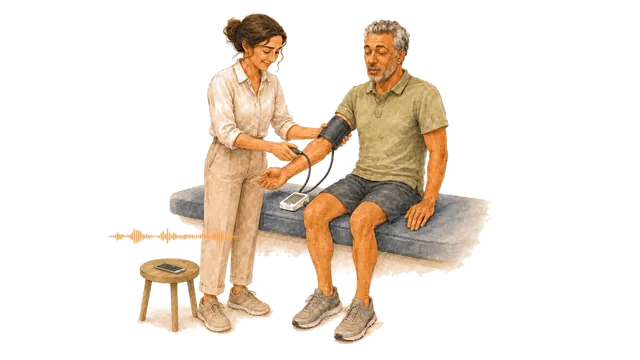
The clerking captured as it happens — history, examination and the initial plan drafted from the conversation, not typed up afterwards.

Built around the hospital day — ward rounds captured, handovers structured, discharge summaries done.
We didn't want ward staff trying to fit a clinic peg into a hospital hole. So Hanah is built for how hospitals operate — shift changes, care teams, the whole length of a stay.
Most scribes are built around clinical workflows and single-clinician visits. Hanah is built to coordinate care teams for patients at every step of their hospital stay.
The clerking captured as it happens — history, examination and the initial plan drafted from the conversation, not typed up afterwards.
Ward rounds and reviews captured through the stay — progress notes, results and plan changes building on one record, not scattered across the chart.
Every shift and ward transfer gets a structured handover, so the next team knows the patient and the plan without re-reading the whole chart.
The discharge summary and GP letter drafted from the admission's own record, ready when the patient moves — not hours later.
Handovers, discharge summaries, outpatient letters — the writing that keeps clinicians back after every shift. Hanah drafts it as care happens, not at the end of the day.
Overnight events, pending results, and what today needs to decide — for every bed, before you get there.
The round is the note. Every detail captured live, in any language — even mid-sentence code-switching.
Every patient you saw is already structured for the next shift — situation, background, assessment, recommendation — the moment the round ends.
Drafted from the whole admission into your hospital's own template — with the GP letter and outpatient follow-up beside it. Ready to review and sign, not to write.

Discharge instructions scanned for jargon, with plain-language explanations one tap away — because the plan only works if the patient understood it.

You’re going home on an anticoagulantAnticoagulant — a blood-thinning medicine that lowers the chance of clots forming while you’re less mobile after surgery. to reduce the risk of a deep vein thrombosisDeep vein thrombosis — a blood clot in the deep veins of the leg. Call us if your calf becomes swollen, warm or painful.. You’re weight-bearing as toleratedWeight-bearing as tolerated — you can put as much weight through the leg as feels comfortable. Keep the frame for the first two weeks. — your follow-up is booked for Thursday.
Follow-ups booked, red flags explained, instructions understood — the loop that keeps discharge day from turning into a return through ED.
Documentation delay is quietly load-bearing: it holds beds, pads unrostered overtime, and backs up outpatient lists. Move the writing to the moment of care and the whole day moves.
The summary is ready when the decision is made — so the bed turns when the patient is ready, not when the paperwork is.
Every shift change gets the same structured picture of every patient — not whatever the last hour of the shift allowed.
After-shift documentation is the classic unrostered overtime. With Hanah it happens in the room, during the round.
The letter is drafted before the next outpatient is called in — not queued behind weeks of dictation backlog.
Hanah isn't an EMR and doesn't want to be one. Clinicians capture care in Hanah; the finished documents land in your record system — from day one, with no integration project gating the start.
Want a direct integration with the system you run? That's exactly the conversation to have with us. Tell us which EMR you use →
Patient records are stored in your region: Australia, New Zealand or the UK. Our DPA names regions where data is processed. Encrypted in transit and at rest. We never train models on your patient data.
No hospital-wide commitment to find out whether it works. Pilot with one team, measure the change in turnaround against your own baseline, then scale on the evidence.
One wardweeks, not quarters · no hospital-wide commitment
Let's talkper-clinician pricing · enterprise agreement
Procurement wants the detail? Start with our public AI accuracy & hallucination report →
Hanah is an AI scribe and documentation platform. It captures ward rounds and consults as they happen, then drafts the notes, handover entries, discharge summaries and outpatient letters — in your hospital's own templates — and keeps patients informed after discharge.
No. Hanah runs alongside your EMR: clinicians capture care in Hanah and the finished documents come out ready to file — text, PDF or Word. There is no migration and no integration project gating the start. Direct integration with your specific system is a conversation we're keen to have.
We publish a standing AI accuracy and hallucination report, including our word-error-rate methodology, and hold ourselves to it publicly. Clinicians review and sign every document before it goes anywhere — Hanah drafts, it never files on its own.
Patient records are stored in your region: Australia, New Zealand or the UK. Our data processing agreement lists which regions each step happens in. Bank-level encryption, and no model training on patient data. The regional Trust Centers list the full controls.
Yes. Bring your existing discharge summary, outpatient letter and transfer letter templates as Word or PDF files and Hanah fills them from the encounter — the output looks like your hospital's paperwork because it is your hospital's paperwork.
One ward or department, running in weeks rather than quarters. Onboarding a clinician takes about 10 minutes. We onboard your templates, agree a baseline for documentation turnaround, and measure against it — then you decide about scaling on the evidence.
Bring a discharge summary template you use today — we'll walk the round-to-discharge flow on it, not a canned demo.