
Physiotherapy management plans: free template and common mistakes
TL;DR
- The shared Code of conduct asks you to "formulate, record and implement a suitable management plan", and the plan has to be written in the record.
- A good plan records the working diagnosis, the patient's goals with a baseline measure, the treatment and home exercise dose, how many sessions over how long, when you will reassess and what happens if the patient is not progressing.
- The common mistakes are goals with no measure, a home program with no dose, a plan that never changes, consent on a generic form at reception and copies that never reach the GP or insurer.
- Download the free fillable management plan PDF. You don't need an account or email address.
- Hanah drafts the management plan for you, either from the consult notes it pulls from your practice management system or directly from your visits and visit history in Hanah. You review the draft before it is saved or sent.
A physiotherapy management plan sets out what you found, what you and the patient are working towards, what you will do about it, and how you will know it is working. Another physio uses it to pick up the patient's care, a GP or insurer reads it to see why treatment should continue, and the patient can check what they agreed to.
The Code of conduct
The shared Code of conduct, which the Physiotherapy Board of Australia applies to registered physiotherapists, lists good patient care as including the need to "formulate, record and implement a suitable management plan". The same code asks for health records that are accurate, up to date, factual, objective and legible, made at the time of events or as soon as possible afterwards.
The Board has published a one-page summary of record-keeping obligations and a self-check tool. The Australian Physiotherapy Association says records should have enough detail for another practitioner to take over the patient's care. It also notes that poor record keeping is often part of complaints made to the Board.
The Board does not prescribe a format. A plan can sit at the end of your initial assessment note, in a separate document, or on an insurer's form, as long as it is recorded and kept up to date.
Contents of a management plan
Across private, Medicare, DVA, NDIS and compensable patients, a plan that holds up usually records:
- the working diagnosis or clinical impression, with region and side, and the findings that support it
- the baseline measures you will use to track progress, with units, such as range of motion, strength, a functional test or a questionnaire like the PSFS
- contributing factors, and the red and yellow flags you screened for and what you found
- the patient's goals in their words, and measurable goals with a baseline, a target and a date
- the interventions you plan and the reason for each
- the home program with sets, repetitions, load and frequency
- the number of sessions you expect and over how many weeks
- the reassessment date, the measures you will repeat and what will make you progress, discharge or refer
- the consent discussion, including the fees, and the patient's agreement
- who gets a copy, such as the patient, the referring GP or the insurer
Free physiotherapy management plan template
Download the fillable PDF (A4) or the plain-text version. Both are free to use, with no account or email address required. The PDF has fillable fields for typing, space to write by hand, and a review log for each time you reassess.
Hanah can draft into this PDF from your visits. Create a free Hanah account, add the downloaded PDF as a template, and Hanah fills each section from the patient's visits and notes. See how to use a PDF template in Hanah.
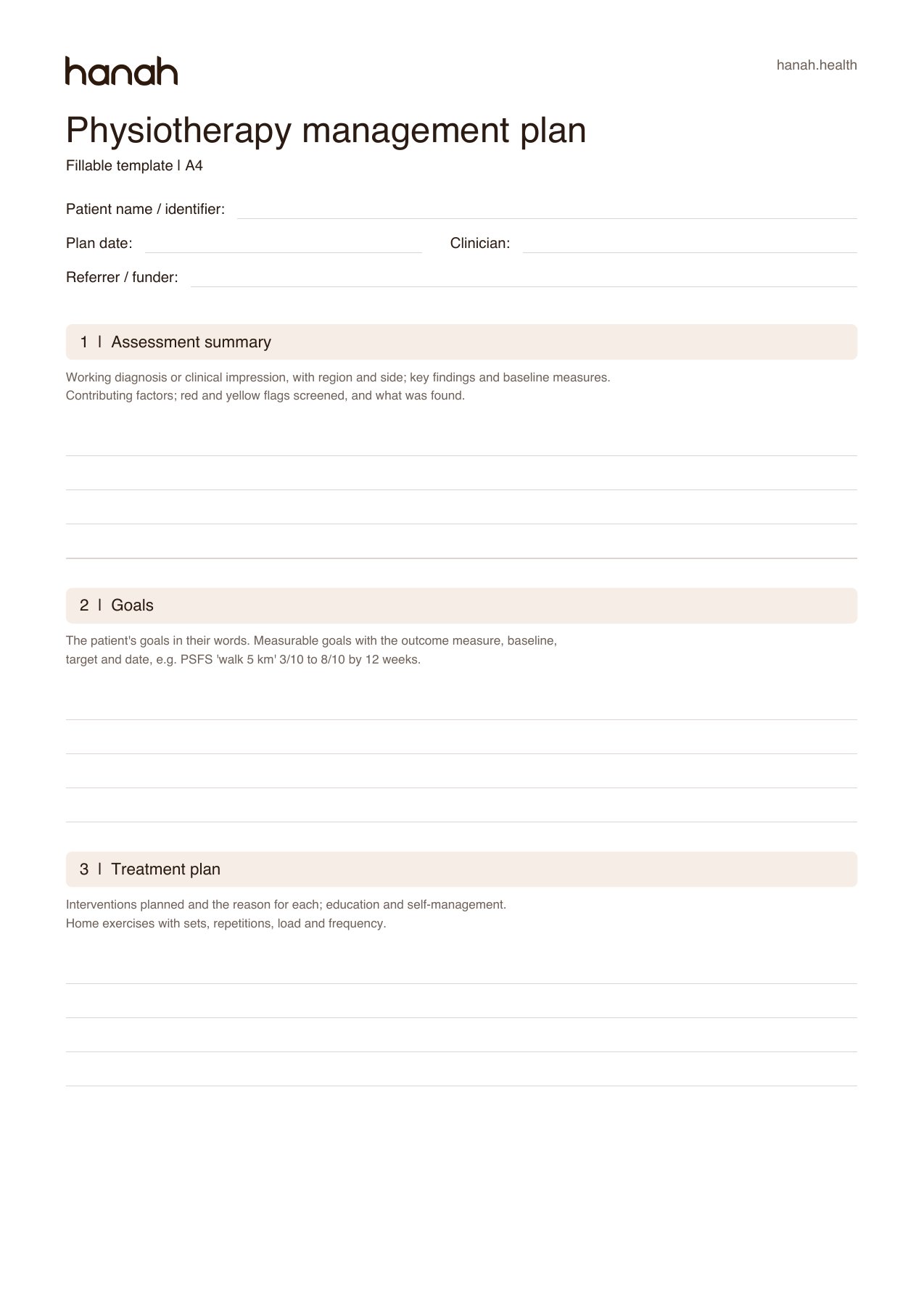
Preview of page one of the A4 PDF. Select it to open the fillable file. Page two covers frequency and review, consent and communication, and the review log.
The template is a general plan. A compensable patient's insurer will usually want a separate form as well, covered further down.
Common mistakes
No plan recorded at all
"Cont. Rx" or "as per plan" at the bottom of every note does not tell the next physio what the plan is. If the plan was discussed in the room, write it down in the initial assessment and again whenever it changes.
Goals with no measure
"Reduce pain and improve function" gives you nothing to check at the review. Tie each goal to something you measured at the start: "PSFS for walking 5 km, 3/10 now, 8/10 by week 12" or "single-leg calf raise 8 reps, target 25 to match the other side". Record the patient's goal too, in their words, because that is what they will judge the treatment by.
No baseline to compare against
Without a baseline, a review can only say the patient "feels better". Pick the measures you will repeat and record them with units and side in the first session. Insurers ask for exactly this: the WorkCover WA treatment management plan has columns for each screening tool's initial score, the date it was re-administered and the later score, and for each functional activity's initial, current and goal level.
A home program with no dose
"HEP given" leaves out what the patient was asked to do. Record each exercise with sets, repetitions, load and how often, and give the patient the same version you recorded. At the next visit you can then progress the dose from a known starting point.
A plan with no end
GPs, insurers and patients paying for treatment all want to know how long it will take. State how many sessions you expect over how many weeks, when you will reassess, and what you will do if the patient is not on track, such as changing the approach, referring for imaging or a medical review, or discharging to self-management.
A plan that never changes
A plan written at the first visit and never touched again doesn't show whether the treatment is working. When you reassess, record the measures you repeated, the progress against each goal and what you changed. If nothing changed, say why you are continuing.
Consent on a form at reception
Guild Insurance, which insures physiotherapists, says that "signing a generic form at reception prior to seeing the practitioner is not informed consent". Consent covers the treatment you propose, its risks and alternatives, and the fees, and the details of that discussion belong in the clinical record. Guild also says poor communication is a feature in almost all treatment-related complaints, and the plan is where that communication is written down.
Copying the referral diagnosis
A referral or certificate gives you the referrer's view. Your plan should record your working diagnosis from your assessment. WorkCover WA's notes on its form say the physiotherapist's diagnosis may differ from the injury description on the certificate of capacity, and that the difference helps the insurer get clarity on the diagnosis.
Copies that never leave the file
Under a GP chronic condition management plan, you send a written report to the referring GP after the first and last service (MBS note MN.3.1). WorkCover WA asks for its plan to go to the worker, the treating medical practitioner and the insurer. Record who you sent the plan to and when.
Writing it days later
The Code asks for records made at the time or as soon as possible afterwards. A plan written from memory at the end of the week loses the measures and the patient's exact goals.
Insurer management plans by state
Compensable patients come with insurer forms. The ones physios meet most often in Australia are:
- WorkCover WA: a Physiotherapy Treatment Management Plan when you expect treatment to go beyond 10 consultations. It covers the diagnosis, screening tools and functional measures, biopsychosocial factors, current work status, return-to-work progression and the sessions you propose. All sections should be completed, and the form expects the insurer to respond within three to five business days.
- WorkSafe Victoria: an Allied Health Recovery Management Plan within the first five consultations, with standardised outcome measures.
- WorkCover Queensland: a Provider Management Plan to request treatment past the pre-approved sessions.
- NSW workers compensation and CTP: an Allied Health Treatment Request to the insurer, including for claims managed by icare.
- TAC: an Allied Health Treatment and Recovery Plan once treatment runs past 90 days from the accident.
- DVA: an end-of-cycle report to the veteran's usual GP after 12 sessions or a year, with validated outcome measures.
Download the current version from the insurer or regulator each time you fill one in. Each of these forms asks for the same core content as the template above, which is why a well-kept plan in the record makes them quick to fill.
Drafting the plan with Hanah
Hanah is an AI medical scribe that drafts physiotherapy management plans in your format, into this template, or into an insurer's Word or PDF form, from either of these:
- Your visits in Hanah. Record the consult, or dictate the plan after the patient leaves, and Hanah drafts the plan from that visit. For a review, it draws on the patient's visit history and puts the baseline from the first visit beside today's measures.
- Your practice management system. When your PMS is connected, such as Cliniko, Hanah pulls the patient's past consult notes from it. A patient you treated for months before you started using Hanah still has that history available for the plan. See how the assistant reads a patient's full history.
Hanah records each finding with the measurement, unit and side you stated, and leaves blank any field the visits did not cover. The same visits can supply the report to the GP and the home program you set, which the patient follows on their phone. You review and edit every draft.
For the note that sits under the plan, see our physio SOAP note template and example. To compare products, see AI scribes for physiotherapists.
Frequently asked questions
What is a physiotherapy management plan?
It is the part of the clinical record that sets out the working diagnosis, the patient's goals, the treatment and home program, how long treatment is expected to take and when it will be reviewed. The shared Code of conduct asks practitioners to formulate, record and implement a suitable management plan.
Is a management plan the same as a treatment plan?
The terms are used interchangeably in physiotherapy. Insurers use other names, such as treatment management plan, recovery management plan or provider management plan, for forms that ask for much the same content.
How often should I update the plan?
Update it whenever you reassess and whenever the plan changes. Set the reassessment date when you write the plan, and record the measures you repeated and what you changed each time.
Do I need written consent for a management plan?
The Code asks you to document consent appropriately and consider whether written consent is needed. Whatever form it takes, record the discussion: the treatment proposed, its risks and alternatives, and the fees.
Can I use this template for WorkCover or TAC patients?
You can use it as the plan in your record. Most insurers also require a separate form, linked above. Check which one applies to the claim.
Can an AI scribe draft a physiotherapy management plan?
Yes. Hanah drafts it from your recorded visits and visit history, or from the consult notes it pulls from your practice management system. It can draft into this template or an insurer's form, and you review the draft before it is saved or sent.
Sources cited in this article
- shared Code of conduct — ahpra.gov.au
- one-page summary of record-keeping obligations and a self-check tool — ahpra.gov.au
- Australian Physiotherapy Association — australian.physio
- WorkCover WA treatment management plan — workcover.wa.gov.au
- "signing a generic form at reception prior to seeing the practitioner is not informed consent" — riskhq.guildinsurance.com.au
- MBS note MN.3.1 — www9.health.gov.au
- Allied Health Recovery Management Plan — worksafe.vic.gov.au
- Provider Management Plan — workcoverqld.com.au
- Allied Health Treatment Request — sira.nsw.gov.au
- Allied Health Treatment and Recovery Plan — tac.vic.gov.au
- end-of-cycle report — dva.gov.au