
ADIME note template and example: writing the PES statement with an AI scribe
Key takeaways
- ADIME follows Assessment, Diagnosis, Intervention, and Monitoring and Evaluation.
- A PES statement links the nutrition problem to its cause and the assessment findings that support it.
- The dietitian supplies the diagnosis and reasoning; the scribe formats what was stated, and the dietitian checks the draft.
The short answer: an AI scribe can draft the whole ADIME note from a recorded consult. It fills Assessment from the diet history and your measurements, formats the nutrition diagnosis you stated as a PES statement, lists the intervention you agreed, and sets out what you'll monitor. You then check it, and the diagnosis needs the closest reading.
Below: a blank ADIME template, ADIME and the PES statement, a worked example, and what to check before you sign. It applies to any scribe. Where we describe one, it's Hanah for dietitians.
Free blank ADIME note template
Copy the template below into your notes, or download the fillable PDF or plain-text version. All three are free to use, with no account or email address required. The PDFs have fillable fields for typing or using as a PDF template in Hanah, and space to write by hand. The text version is editable in your usual notes software.
For dietitians in the United States, download the US English PDF (US Letter) or US English text version. The original PDF uses A4 paper. Both versions follow the same ADIME structure.
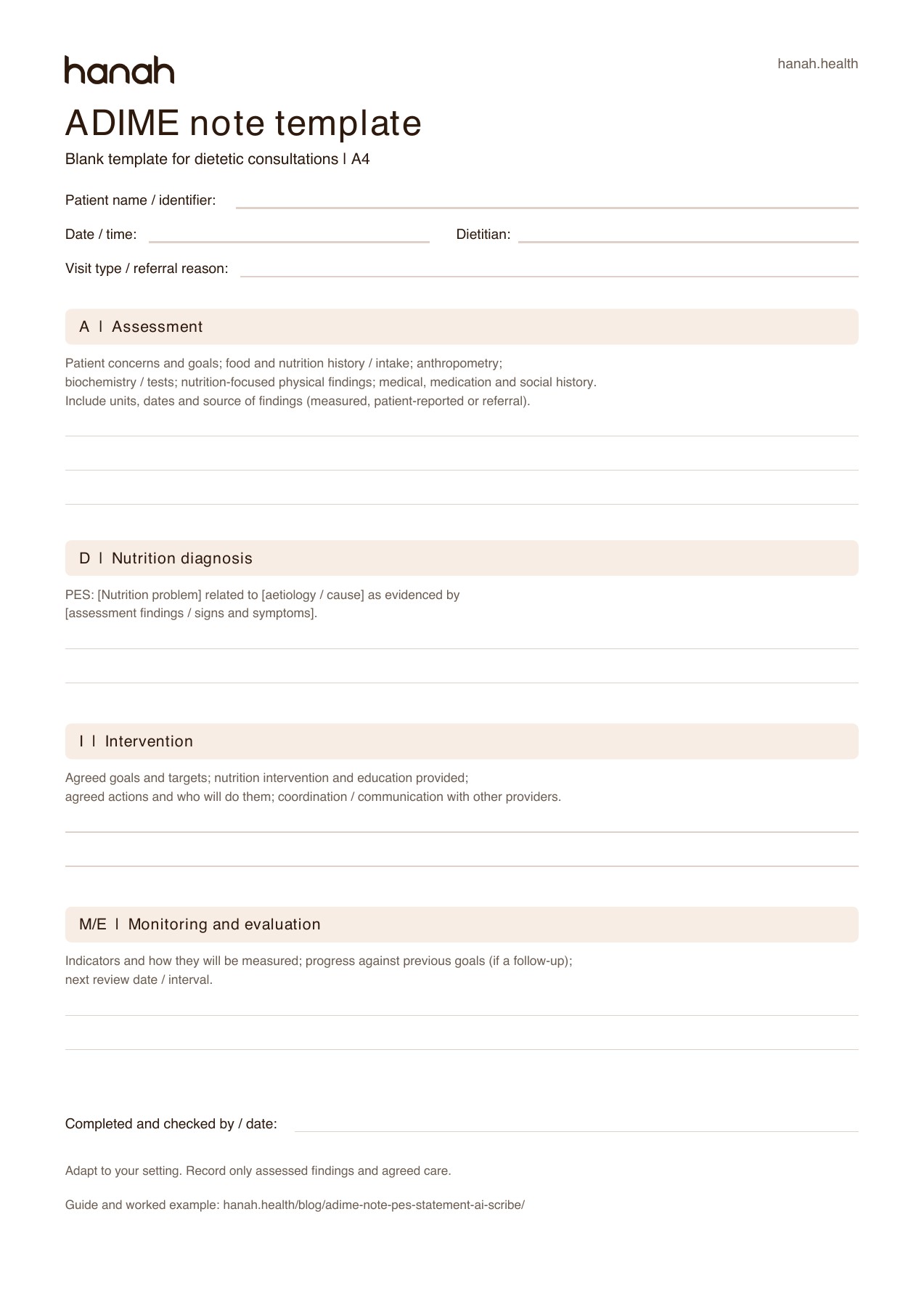
Preview of the A4 PDF. Select the preview to open the printable file.
Adapt the prompts to the consultation and your workplace's documentation requirements. Record the findings you assessed, your own nutrition diagnosis and the care you agreed with the patient. Leave out prompts that do not apply.
ADIME NOTE

Patient name / identifier: [ ]
Consultation date and time: [ ]
Dietitian: [ ]
Visit type and reason for referral: [ ]

A - ASSESSMENT
Patient concerns and goals: [ ]
Food and nutrition history / intake: [ ]
Anthropometric measurements, with units and dates: [ ]
Relevant biochemistry / medical tests, with dates: [ ]
Nutrition-focused physical findings: [ ]
Relevant medical, medication and social history: [ ]
Source of findings (measured, patient-reported or referral): [ ]

D - NUTRITION DIAGNOSIS
PES statement:
[Nutrition problem] related to [aetiology / cause]
as evidenced by [assessment findings / signs and symptoms].

I - INTERVENTION
Agreed goals and targets: [ ]
Nutrition intervention and education provided: [ ]
Agreed actions and who will do them: [ ]
Coordination / communication with other providers: [ ]

M/E - MONITORING AND EVALUATION
Indicators to review and how they will be measured: [ ]
Progress against previous goals (if a follow-up): [ ]
Next review date / interval: [ ]

Completed and checked by / date: [ ]
Want a draft from your consultation? Create a free Hanah account to use the ADIME note format. You supply the clinical reasoning and check the draft before saving it. You can also bring this downloaded template into Hanah using your own Word or PDF template.
What is an ADIME note?
ADIME stands for Assessment, Diagnosis, Intervention, and Monitoring and Evaluation. It's a note format that follows the four steps of the Nutrition Care Process, the framework the Academy of Nutrition and Dietetics describes for individualised nutrition care.
Dietitians Australia's National Competency Standards describe the same four steps and ask for accurate, timely documentation. ADIME is one way to write that down; SOAP and workplace formats are others.
What goes in each section?
- Assessment. The Academy lists five kinds of data: food and nutrition-related history, biochemical data and medical tests, anthropometric measurements, nutrition-focused physical findings, and client history. In practice that means the diet history or 24-hour recall, weight, height, BMI and waist, recent bloods, medications, and the social context that shapes how the person eats.
- Diagnosis. The nutrition problem you'll treat, written as a PES statement. It's a nutrition diagnosis, not a medical one.
- Intervention. What you'll do about the problem: the goals and targets you agreed, the education you gave, and any coordination with the GP or other providers.
- Monitoring and Evaluation. The indicators you'll use to tell whether the problem is improving, and when you'll review them.
The Academy notes the steps aren't always linear. New information halfway through a consult can send you back to reassess and rediagnose.
What is a PES statement, and how do you write a good one?
PES stands for Problem, (A)etiology, and Signs and symptoms. The Academy's nutrition diagnosis snapshot gives the format as:
[Problem] related to [aetiology] as evidenced by [signs and symptoms].
- Problem. A nutrition diagnosis term. Standardised terms sit in three domains: Intake (too much or too little of a food or nutrient), Clinical (problems tied to medical or physical conditions) and Behavioural-environmental (knowledge, beliefs, environment, access to food, food safety). "Inconsistent carbohydrate intake" is a nutrition diagnosis. "Type 2 diabetes" is not.
- Aetiology. The root cause, one your intervention can act on.
- Signs and symptoms. The assessment data that show the problem exists, and that you can measure again to show change.
The snapshot suggests a few checks. Choose the most important and urgent problem. When two diagnoses from different domains fit equally well, prefer the Intake one. Make sure your intervention addresses the aetiology, and that the signs you name will show whether the problem resolves. If the assessment doesn't support a diagnosis yet, "no nutrition diagnosis at this time" is a legitimate entry.
What does a finished ADIME note look like?
Illustrative example only. The patient is fictional. A 54-year-old man is referred by his GP for type 2 diabetes. This is his initial consult. The diagnosis, reasoning, interventions and monitoring below are supplied by the dietitian; they are not conclusions generated by the scribe.
Assessment
- Weight 92.4 kg (measured today), reported stable over 6 months
- Height 172 cm, BMI 31.2 kg/m²
- Waist 108 cm
- HbA1c 8.1% (65 mmol/mol), from the GP referral
- Home glucose, past 2 weeks: fasting 7–9 mmol/L; 2 hours after dinner 11–13 mmol/L
- Medication: metformin 1 g twice daily
- 24-hour recall (a typical work day): no breakfast; large full-cream flat white at 10 am; two sushi rolls at lunch; muesli bar at 3.30 pm; about 2.5 cups cooked pasta with bolognese sauce and 2 slices of garlic bread at 7.30 pm; 2 plain sweet biscuits at 9 pm
- Skips breakfast on most work days; most of the day's carbohydrate is eaten at and after dinner (dietitian's estimate from the recall)
- Warehouse supervisor on rotating shifts; partner cooks most dinners; walks 20 minutes, 3 days a week
- Wants steadier glucose readings before his GP review in 3 months
Diagnosis
Inconsistent carbohydrate intake related to the lack of a meal routine that fits rotating shifts, as evidenced by breakfast skipped on most work days, most daily carbohydrate eaten at and after the evening meal, and glucose readings of 11–13 mmol/L two hours after dinner.
Intervention
- Breakfast on work days (agreed options: overnight oats, or wholegrain toast with eggs)
- Carbohydrate spread across three meals and one snack; plate model at dinner, with pasta at a quarter of the plate and extra vegetables
- After-dinner biscuits swapped for fruit or plain yoghurt
- Education: carbohydrate foods and portions, the plate model, reading the carbohydrate line on food labels
- Report to the referring GP after this first service
Monitoring and Evaluation
- Breakfast frequency on work days (food diary)
- Spread of carbohydrate across the day (food diary and recall)
- Glucose 2 hours after dinner (patient's meter)
- Weight and waist
- HbA1c at the GP's 3-month review
- Review in 4 weeks
Notice how the sections line up. The signs in the PES statement come straight from Assessment. The intervention targets the aetiology, which is the meal routine. Monitoring measures the same signs again.
How does an AI scribe draft each section from the consult?
A scribe works from the transcript, so each section comes from a different part of the conversation.
- Assessment comes from the diet history, the recall, and anything you say aloud while measuring. In Hanah's starter ADIME template, this section asks for anthropometrics, intake and relevant history, with each figure and its units on its own line.
- Diagnosis records the diagnosis and reasoning you supplied as a PES statement: problem, related to aetiology, as evidenced by signs and symptoms. The scribe does not choose a diagnosis from the assessment findings. Hanah's shorthand preview abbreviates the links to "r/t" and "AEB".
- Intervention comes from the end of the consult, where you agree changes and explain them. Hanah's template lists the targets set and the topics covered.
- Monitoring and Evaluation usually comes from the closing minutes and the booking conversation. The template names each indicator, then the review interval.
Two drafting rules matter here. Hanah takes clinical facts only from the session (the transcript, plus anything you type into the visit's notes) and is told not to infer or invent. A section with no data is left out rather than filled. The template is also yours to change: rename sections, allow more than one PES statement, or bring your own Word or PDF template.
Two habits help with any scribe. Say measurements aloud as you take them ("waist, one-oh-eight"). And close with a short recap to the patient: what you've noticed, what you're changing, and when you'll check. That recap is the cleanest material the scribe will get for the Diagnosis, Intervention and Monitoring sections.
What does the dietitian still need to check?
Check that the Diagnosis section faithfully records your stated diagnosis and reasoning, without adding an interpretation of its own. Before you sign:
- The problem is a nutrition diagnosis. It should be the standardised term you'd use, not a medical condition or a vague label.
- The aetiology is a root cause you can act on, not the problem restated in different words.
- The signs and symptoms appear in Assessment and can be measured again.
- The intervention addresses the aetiology, and Monitoring measures the signs. If either link is missing, the note doesn't hold together.
- The numbers and units are right, and it's clear which were measured today and which were reported.
- Anything you didn't say aloud is there. That includes a weight read off the scale, bloods from the referral, and physical findings you noticed without mentioning. Say it, type it into the visit, or add it to the note.
- Nothing was added. Check for foods, supplements or advice that never came up.
Frequently asked questions
Can an AI scribe write the PES statement for me?
It can format the diagnosis, aetiology and supporting signs you explicitly state or type into the visit as a PES statement. You supply the diagnosis and reasoning; the scribe does not infer them from the diet history or measurements. Check the draft against what you provided.
Can an ADIME note have more than one PES statement?
Yes, when there are separate problems that each need an intervention. The Academy's guidance is to start with the most important and urgent one. Hanah's starter template asks for one, and you can edit it if you routinely write more.
Is ADIME required in Australia?
Not by Dietitians Australia's competency standards, as far as we can find. They describe the Nutrition Care Process and ask for accurate, timely records, without mandating a note format. Check your employer's or health service's documentation policy.
Does the scribe calculate energy intake from a 24-hour recall?
The ADIME note records the estimate you state in the consult. Nutrition calculations happen in Hanah's meal plans, where each ingredient is looked up in FSANZ food composition data.
Can the same consult produce the report for a Medicare referral?
Yes, if you have a letter template. Services Australia says that under a GP chronic condition management plan, you report to the referring GP after the first and last service. The report covers assessments, treatment provided and recommendations. An ADIME note already holds most of that.
For a wider look at what to ask of any scribe, read choosing an AI scribe for dietitians, or see how Hanah works for dietitians.
Sources cited in this article
- Academy of Nutrition and Dietetics — ncpro.org
- National Competency Standards — dietitiansaustralia.org.au
- nutrition diagnosis snapshot — andeal.org
- FSANZ food composition data — foodstandards.gov.au
- Services Australia — servicesaustralia.gov.au
Update note: Added a blank ADIME note template with an inline PDF preview, copy, PDF and plain-text download options, including a US English version on US Letter paper.